The Mountain Within: A Technical Manifesto on Mastering Celeste

The Mountain Within: A Technical Manifesto on Mastering Celeste
Celeste is frequently lauded as a masterpiece of narrative-driven platforming, but beneath its poignant story of mental health and perseverance lies one of the most mechanically dense engines in the history of the genre. To "master" Celeste is not merely to reach the summit of the mountain; it is to understand the frame-perfect interactions between Madeline’s physics and the environment. This game operates on a logic of sub-pixel positioning and coyote time, rewarding players who can move beyond instinctive jumping into the realm of technical execution. This guide provides a deep-dive into the high-level mechanics, speedrunning techniques, and psychological conditioning required to conquer the B-Sides, C-Sides, and the grueling Farewell chapter.
1. The Physics of Intent: Understanding Madeline’s Core Movement
Before attempting the mountain's steeper faces, a player must internalize the grace periods built into Celeste’s code. The most vital of these is Coyote Time. When Madeline walks off a ledge, the game allows for a brief window (approximately 5 frames) where she can still jump despite technically being in mid-air. Mastering this allows you to maximize horizontal distance, jumping at the absolute last micro-second to clear gaps that seem mathematically impossible. Similarly, Jump Buffering allows you to input a jump command up to 4 frames before touching the ground, ensuring that Madeline leaps the instant she makes contact, preserving every ounce of momentum.
Another hidden layer is the Stamina System. Unlike many platformers, Madeline cannot climb indefinitely. Climbing consumes stamina, while jumping away from a wall consumes a larger chunk. However, "Neutral Jumping"—releasing the directional pad and jumping while against a wall—allows Madeline to gain height without consuming stamina. This is the first pro-tier skill every player must learn. By alternating between holding the wall and performing neutral jumps, you can effectively scale infinite vertical surfaces, bypassing the intended resource management of many early-level puzzles.
2. Dash Manipulation: Vector Control and Dash-Canceling
The dash is Madeline’s defining ability, but its utility extends far beyond a simple burst of speed. A dash in Celeste is a fixed-distance vector, but its interaction with terrain can be manipulated. When you dash into a corner (a Corner Boost), the game’s collision engine attempts to "shove" Madeline around the obstacle to prevent frustration. Technical players exploit this to gain a massive speed boost. By dashing horizontally into a corner and jumping at the exact moment of contact, you convert the dash’s force into a high-velocity leap that carries you twice as far as a standard jump.
Furthermore, understanding Dash-Canceling is essential for precision platforming. If Madeline dashes and then immediately performs a different action—like grabbing a crystal or hitting a spring—the dash distance is truncated, but the momentum properties can sometimes linger. This is particularly relevant in Chapter 5 (Mirror Temple), where dashing into "Red Bubbles" requires a specific angle to ensure the exit trajectory aligns with the next platform. You aren't just dashing to a point; you are using the dash to anchor Madeline's momentum for the next three moves in the sequence.
3. The Superdash and Hyperdash: Engineering Velocity
To move from a casual player to a technical expert, you must master the Superdash. By dashing horizontally on the ground and jumping shortly after, Madeline performs a long, high-arc jump that retains dash speed. This is the foundation of high-speed traversal. However, the Hyperdash takes this further: by dashing down-diagonally while on the ground and jumping, you stay closer to the floor but move at an even higher velocity. This is the engine of speedrunning, allowing you to skip entire screens of platforming.
Advanced Velocity Variations
- Extended Hyperdash: If you delay the jump slightly during a Hyperdash, you regain your dash charge in mid-air while keeping the speed.
- Wavedashing: Introduced in Chapter 9, this involves jumping into a down-diagonal dash so that you hit the ground and jump again instantly. It is the airborne version of the Hyperdash.
- Ultra Dashes: By dashing down-diagonally while already moving at high speed (usually from a previous boost), you gain a 1.2x speed multiplier.
4. Dreaming in Static: Navigating the Chapter 2 Dream Blocks
Chapter 2 (Old Site) introduces Dream Blocks—star-filled squares that Madeline can dash through. While they seem simple, they are the source of the Dream Jump. If you press the jump button the moment Madeline exits a Dream Block, she gains a massive vertical and horizontal boost. This is not taught by the game explicitly until much later, but mastering it early allows for significant sequence breaking. The window is tight (roughly 3 frames), requiring a rhythmic one-two tap of the dash and jump buttons.
The technical nuance here is the Multi-Block Transition. In later B-Sides, you will encounter multiple Dream Blocks in a row. To maintain momentum, you must dash through the first, Dream Jump into the second, and immediately dash again. This requires a buffered input where you are holding the direction of the next block before even exiting the current one. This is where Celeste begins to feel less like a platformer and more like a rhythm game, where the beat is the sound of the dash recharge.
5. Wind and Weight: Chapter 4’s Atmospheric Physics
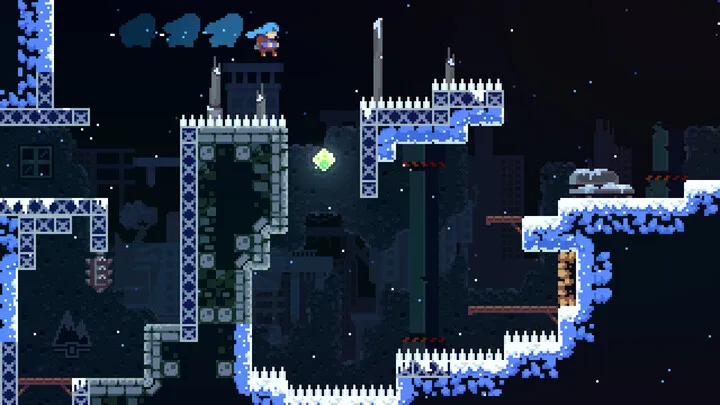
Chapter 4 (Golden Ridge) introduces wind physics, which modify Madeline's acceleration constants. Upward wind increases jump height, while horizontal wind acts as a constant force vector applied to her X-axis. To fight strong headwind, you must use Crouch-Jumping. By crouching before jumping, Madeline’s hitbox is smaller, and her initial takeoff frames interact differently with the wind’s push. It is a subtle difference, but in the Golden Ridge C-Side, it is the only way to clear the final gust-heavy gaps.
Wind Velocity Management
- Wind-Sprinting: Dashing with the wind increases your dash distance by approximately 15%.
- Cloud-Bouncing: If you jump off a cloud at the peak of its upward animation, the wind will carry you across the entire screen.
- The Wind-Dash Cancel: Dashing against the wind and immediately grabbing a wall allows you to lock your position without being pushed back.
6. Seekers and Cycles: Predictive Pathing in the Mirror Temple
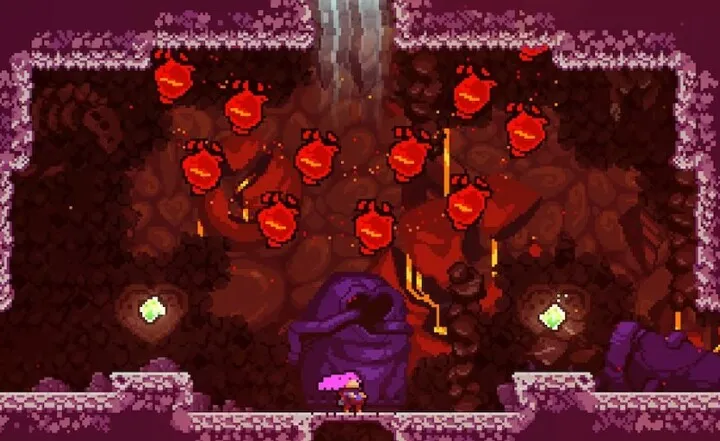
Chapter 5 moves away from pure platforming and into Cycle Management. The Seekers follow a predictive AI pathing. They don't just chase Madeline; they lunge when she enters a certain proximity. Mastering Seekers requires understanding their stun-timer. When a Seeker hits a wall, it is stunned for a fixed duration. You can use this time to perform a Theo-Crystal toss, which is a unique physics interaction where Madeline's horizontal velocity is added to the crystal’s throw vector.
Theo-Crystal mechanics are the peak of Chapter 5's technicality. You must learn the Regrab—throwing the crystal, jumping, and grabbing it again mid-air to clear large gaps. This effectively gives Madeline a portable platform. In the B-Side, you will need to perform a Mid-Air Throw-to-Dash, where you release the crystal, dash through a barrier, and catch the crystal on the other side before it falls into a pit.
7. The Core’s Heat: Managing Dash Depletion
Chapter 8 (The Core) fundamentally changes the game by removing the dash recharge upon touching the ground. You only regain your dash by touching a crystal or a specific ice/fire switch. This forces a transition from momentum-based play to Resource Optimization. Every dash becomes a precious commodity. The tip here is to use the Slide-Jump. By sliding down a wall and jumping, you gain horizontal momentum without using a dash, preserving your charge for the inevitable lava-spikes ahead.
In the fire sections of the Core, the game introduces Heat Bouncing. Dashing into certain surfaces will launch Madeline in the opposite direction. The technical trick is to use a Reverse Super (dashing away from your destination and jumping back) to gain speed while moving toward the goal. This counter-intuitive movement is essential for the Core’s C-Side, where the margin for error is less than a single tile.
8. Farewell to Logic: Mastering the Jellyfish and Electricity
Chapter 9 (Farewell) is a ten-hour gauntlet that introduces the Jellyfish. These are not just items; they are paragliders. The physics of the jellyfish are tied to Madeline’s falling speed. By tapping the grab button (Jelly-Gliding), you can maintain a specific glide slope. The most advanced tip is the Jelly-Dash: throwing the jellyfish, dashing, and regrabbing it. This allows you to "climb" vertically in open space without any walls.
Jellyfish Mastery Steps
- The Neutral Drop: Drop the jellyfish without a directional input to keep it perfectly stationary.
- The Jelly-Spring: Throw the jellyfish into a spring so it bounces back to you, allowing you to clear electric barriers that Madeline cannot pass through alone.
- The Up-Throw Buffer: Throwing the jellyfish upward while moving at high speed gives you enough time to perform a wavedash underneath it before catching it again.
9. Sub-Pixel Precision: The Golden Strawberry Challenge

The ultimate test in Celeste is the Golden Strawberry, which requires completing an entire chapter without a single death. This requires more than just skill; it requires a Routing mindset. You must find the safest, most consistent way through every screen. This often means intentionally slowing down—avoiding high-speed hyperdashes in favor of stable, predictable jumps. Consistency is the enemy of speed, and for Golden Strawberries, consistency is king.
A major tip for Golden runs is to identify Save Points—areas within a screen where you can stand safely and breathe. Even in the most chaotic screens of 7B (The Summit), there are tiny ledges where the stamina doesn't drain. Finding these allows you to break a 30-second platforming sequence into three 10-second chunks, drastically reducing the mental load and the likelihood of a "choke" near the end of the run.
10. The Psychological Peak: Managing Tilt and Muscle Memory
Celeste is as much a mental game as a physical one. The game’s death count is a badge of honor, but "Tilt" is the primary cause of failure in the C-Sides. When you fail a jump fifty times, your muscle memory begins to "compensate," leading to over-correction. The most effective guide for the summit is the Take Five rule. If you miss a specific wavedash ten times in a row, your brain’s neural paths are literalizing the mistake. Stepping away for five minutes resets your internal clock.
Furthermore, utilize Assist Mode not as a cheat, but as a Practice Tool. If you are struggling with the final screen of Farewell, use Assist Mode to slow the game speed to 50%. This allows you to see the sub-pixel interactions and the specific frame-windows for the jellyfish regrabs. Once you understand the rhythm at 50% speed, increasing it back to 100% feels like learning a song—you are no longer reacting; you are performing.
Conclusion
Celeste is a mountain that never truly ends. Even after the C-Sides are cleared and the moon berry is collected, the depth of its movement engine offers infinite room for refinement. From the subtle grace of coyote time to the violent velocity of an ultra-dash, Madeline’s journey is a masterclass in player agency. By viewing every death as a lesson in physics and every screen as a puzzle of momentum, you move beyond the frustration of the climb. The mountain is difficult, but it is fair. Mastery isn't about never falling; it's about knowing exactly why you fell and having the technical vocabulary to ensure that next time, you fly.