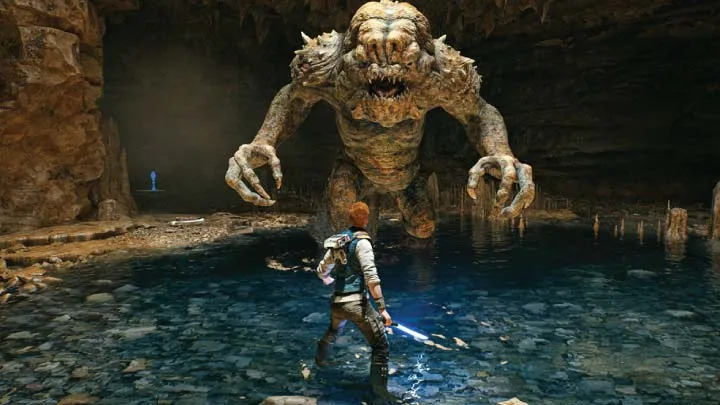


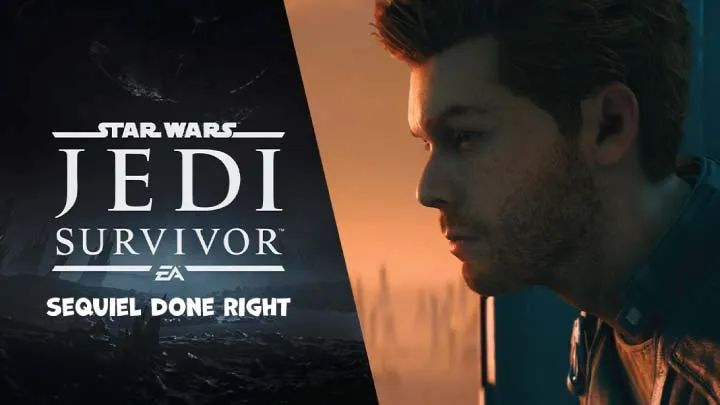
The core issue within Star Wars Jedi: Survivor lies in the "sequel power reset" problem common to the Metroidvania genre. Unlike Fallen Order, where Cal was a Padawan regaining lost knowledge, Survivor begins with a Cal who is a seasoned guerrilla fighter. The game attempts to honor this by letting him keep his core abilities—like the double jump and push/pull—but it immediately introduces new barriers that feel arbitrarily designed to hinder a Jedi of his caliber. This tension between being a "Jedi Knight" and a "Level 1 Video Game Protagonist" serves as the primary axis of mechanical friction throughout the experience.
This article explores the specific ways in which Survivor attempts, and sometimes fails, to justify its locked doors and impassable terrain. We will examine the evolution of these barriers from industrial to biological, the impact of the "Force Tear" system on narrative immersion, and how the game’s insistence on "locked shortcuts" undermines the feeling of playing as a master of the Force.
The Padawan’s Legacy vs. The Knight’s Reality
In Fallen Order, every new ability Cal unlocked felt like a personal victory and a narrative milestone. When he remembered how to "Wall Run" or "Force Pull," it was a direct reflection of his healing psyche. In Survivor, this organic link is largely severed. Because Cal starts the game with most of his basic toolkit, the developers had to invent increasingly specific environmental obstacles—such as green laser gates or cobalt-crusted matter—that require highly specific, often non-Force-related upgrades to bypass.
The issue here is that these obstacles often feel "gamey" rather than "Star Wars." For a Jedi who can move massive boulders with his mind, being stopped by a small cluster of blue crystals or a locked electronic door feels like a regression. This creates a psychological gap for the player where Cal’s narrative strength is undermined by the world's mechanical stubbornness, leading to a feeling that the environment is designed specifically to bully a Jedi.
Industrial Barriers and the Illusion of Choice
Early in the game, specifically on Coruscant and Koboh, the progression is gated by traditional industrial locks. These are the most egregious examples of the narrative-mechanical split. Cal frequently encounters doors that are "locked from the other side" or elevators that require a specific droid upgrade to activate. While these are staples of level design, they clash with the "Tree Thinking" logic that the user values—where components should be broken down to their smallest parts.
If we apply a Growth Mindset to this problem, we see that the "component" causing the issue is the lack of environmental interactivity. A Jedi should be able to cut through most doors or jump over most fences. By denying these options, the game forces the player into a linear path disguised as an open world. This creates a "Gốc cây" (Goal) of exploration that is constantly being thwarted by "Rễ cây" (Factors) that don't logically align with the protagonist's established skill set.
Types of Industrial Gates
- Scomp Link Terminals: Forces a reliance on BD-1, making Cal feel less like a self-reliant Force user.
- One-Way Shortcuts: Doors that can only be opened from behind, defying the logic of a circular exploration path.
- Electrical Pylons: Requiring specific ammunition types for the blaster stance, further moving the "Key" away from the Force.
The Introduction of Biological Matter: Koboh's Cobalt Problem
As the narrative shifts focus to the High Republic and the hidden world of Tanalorr, the gating shifts from industrial to biological. The "Koboh Matter"—a purplish, crystalline substance—becomes the primary blocker. This is a clever attempt by Respawn to create a "Star Wars-flavored" obstacle, but it introduces a new issue: the "Janitor Mechanic."
To clear this matter, Cal must use a grinder tool attached to BD-1. This turns a high-stakes Jedi adventure into a series of cleaning puzzles. The issue is that there is no Force-based solution to this problem. Even the most powerful Jedi in the game cannot "push" the matter away; they must use a specific gadget. This reinforces the idea that Cal is a "gadget-user" first and a "Jedi" second, which dilutes the fantasy of the Force being an all-encompassing power.
Force Tears and the Abstraction of Challenge
One of the most controversial additions in Survivor is the "Force Tear" system. These are literal cracks in reality that transport Cal to an abstract challenge room. While they provide excellent combat and platforming tests, they represent the total surrender of narrative logic to mechanical necessity. Within a Force Tear, the laws of physics and the rules of the Star Wars universe are suspended for the sake of "The Grind."
This creates a significant problem for immersion. If Cal can survive a Force Tear where he must jump between disappearing platforms while being shot at by dozens of droids, why does he struggle to climb a slightly overgrown wall in the "real" world? These challenges highlight the "components" of the game that are purely mechanical, breaking the MECE (Mutually Exclusive, Collectively Exhaustive) principle of a cohesive world-building strategy.
The Grappling Hook and the Death of Verticality
In an effort to expand exploration, Survivor introduces an Ascension Cable (grappling hook). While it makes movement faster and more dynamic, it fundamentally changes the "Rễ cây" of Cal’s mobility. In the first game, verticality was earned through Force-enhanced jumps. In the sequel, verticality is often "bought" via a button prompt at a specific grapple point.
The specific issue here is "Point-to-Point" movement versus "Free" movement. The grappling hook only works on specific, pre-determined anchors. This makes the world feel like a series of "nodes" rather than a continuous landscape. It limits the player's ability to use their "Growth Mindset" to find creative solutions to puzzles, as they are restricted to the paths the developers have "grappled" for them.
The Stance System and the Illusion of Mastery
Survivor introduces five distinct combat stances, but the player can only equip two at a time. This is a purely mechanical constraint designed to force players to make "tactical choices," but it makes zero narrative sense. Why would Cal Kestis, a master of multiple forms, "forget" how to use a staff just because he pulled out a crossguard saber?
This creates a "component" failure in the combat logic. During high-pressure environments, the player might realize that a specific stance is the "Root" solution to an enemy type, but they are barred from using it because they didn't equip it at a meditation circle. This turns the Jedi’s adaptability into a menu-management task, contradicting the flow of a real-time combat encounter.
Combat Stances and Their Gaps:
- Single: The baseline, but often feels redundant in the face of specialized stances.
- Double-Bladed: Great for crowds, but lacks the "impact" required for the game's more heavy-set biological bosses.
- Dual Wield: High risk, but the "cancel" mechanic makes it feel disconnected from the weight of the other styles.
- Blaster: A narrative leap that sometimes feels like "Bloodborne" light rather than Star Wars.
- Crossguard: Slow and methodical, often clashing with the high-speed "sliding" physics of the enemies.
Mounts and the Dilution of the Environment
To handle the larger maps of Koboh and Jedha, Survivor introduces creature mounts. While they are charming, they act as living "keys." For example, the Nekko mount is required to jump up slippery slopes. This is another example of a "Specific Issue" where the environment is artificially made impassable to Force-users just so a new mechanic can have a purpose.
Instead of Cal using the Force to gain traction or create a path, he is entirely dependent on a bird or a lizard. This moves the "Cành và Lá" (Branches and Leaves) of the gameplay further away from the "Gốc" (Goal) of feeling like a Jedi. The environment stops being a puzzle to be solved with the Force and starts being a series of "Mount-Specific" gates that feel like roadblocks in a theme park.
The "Green Gate" and Late-Game Backtracking
Late in the story, Cal gains the ability to dash through green laser shields. This is a classic Metroidvania "ability gate." However, because these gates are placed everywhere in the early levels, it forces a massive amount of backtracking that feels like "padding" rather than "exploration."
When a player sees a green gate in the first hour but can't pass it until the twentieth, it creates a "Negative Status" in the player's mental map. The "Component" of exploration becomes a chore of memory rather than a joy of discovery. This is particularly jarring because Cal dash-jumps through these gates using a "charm" given to him by Merrin, rather than his own Force power, once again outsourcing his agency to an external item.
The High Republic Chambers: Puzzles in a Vacuum
The "Jedi Chambers" found throughout Koboh are meant to be the equivalent of Zelda's Shrines. They are dense, mechanical puzzles that often involve lasers and "Koboh Grinder" matter. While intellectually stimulating, they feel completely disconnected from the rest of the world’s "Root" logic.
These chambers often feel like they belong in a different game. They rely on "component" interactions—like moving a block to block a laser to clear a path—that never appear in the main story missions. This lack of integration means that the skills the player learns in these chambers are "Mutually Exclusive" from the skills they need to finish the game, violating the MECE principle of utility-first design.
Conclusion: The Struggle for Narrative Purity
Star Wars Jedi: Survivor is a victim of its own genre. By choosing the Metroidvania path, it has committed to a cycle of "locking and unlocking" that is fundamentally at odds with the "Growth Mindset" of a Jedi Knight. The specific issue of ludonarrative dissonance—where Cal’s power as a character is constantly throttled by the game’s desire for gated progression—remains the series' biggest hurdle.
To truly solve this problem, future installments must move away from "external keys" (grinders, mounts, charms) and return to the "Root" of Jedi power: the Force itself. The environment should be a canvas for the player's creativity, not a series of rigid locks waiting for the right tool. Only then will the "Branches and Leaves" of the gameplay truly flourish from the "Root" of the Star Wars fantasy.